 ⭐⭐⭐⭐⭐ 4.7/5 based on over 300 reviews ✅
 Free shipping on orders of €35 or more, or to a package pickup location
 30-Day Money-Back Guarantee

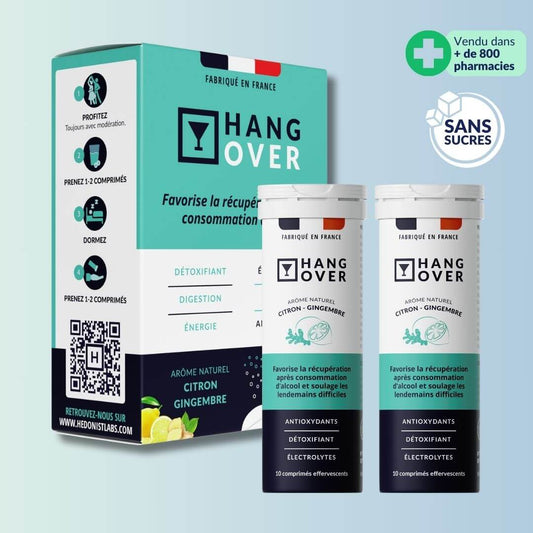
Our research team has found the ideal formula to solve this problem.
Vitamin C
Vitamin C (ascorbic acid) is a water-soluble vitamin that is essential for the proper functioning of the human body. It plays a role in the synthesis of collagen, carnitine, and neurotransmitters. Most animals can produce it on their own, but humans cannot. [1]
Vitamin C enables the synthesis of neurotransmitters in the brain, such as dopamine, norepinephrine, epinephrine, and serotonin. These molecules, released by neurons, are essential for the brain to function properly; they improve cognition and help stress and fatigue . [2]
An additional intake of vitamin C can help you limit the disruption to these neurotransmitters caused by alcohol consumption.
Vitamin B6
Vitamin B6, also known as pyridoxine, is one of the essential water-soluble vitamins. It is abundant in our diet. As a coenzyme, vitamin B6 is involved in approximately one hundred enzymatic reactions, including the biosynthesis of amino acids and neurotransmitters (dopamine, serotonin, and norepinephrine). It plays an important role in the energy metabolism network. [3]
The combination of vitamins C and B6 promotes the biosynthesis of these neurotransmitters. Noradrenergic neurons (such as those in the locus coeruleus) ensure continuous tonic firing during the waking state.[4]
Ginseng
Ginseng (Panax ginseng) owes its name to the Latin word panacea, which literally translates to “a cure for all illnesses and a source of longevity, physical strength, and resilience.”
Ginseng is one of the well-known plants that have been used since ancient times, particularly in the East, where it is still consumed as part of traditional medicine. Its numerous benefits and properties are attributed to the presence of ginsenosides, of which ginseng contains about forty varieties.[5,6]
It has been shown that ginseng consumption has positive effects on the central nervous system, particularly on cognitive function, memory, and learning ability.[7,8] Thanks to their tonic effects, the ginsenosides Rg1 and Rb1 have been shown to enhance cognitive performance.[9,10,11]
Ginger
Ginger (Zingiber officinale roscoe) is one of these natural products and is probably the most widely used worldwide. The oleoresin from the rhizome consists of 115 bioactive compounds. Gingerol appears to be the main component, although shogaols are also present.[12]
Ginger has been used since ancient times for its invigorating properties, as it promotes the release of catecholamines and thus strengthens the body.[13] This energy boost is particularly appreciated in the hours following heavy alcohol consumption.
Thanks to its invigorating effect, this combination promotes the release of the catecholamine adrenaline, which provides an energy boost.
The combination of vitamins C and B6, ginger, and ginseng thus helps reduce fatigue and maintain normal energy metabolism.
[1] Vitamin C (Ascorbic Acid). Muhammad Abdullah; Radia T. Jamil; Fibi N. Attia. Stats Pearls [Internet]. May 22, 2020.
[2] (Harrison, F. E. A critical review of vitamin C for the prevention of age-related cognitive decline and Alzheimer's disease. J Alzheimers.Dis. 2012
[3] Parra M, Stahl S, Hellmann H. Vitamin B₆ and Its Role in Cell Metabolism and Physiology. Cells. 2018;7(7):84. Published 2018 Jul 22. doi:10.3390/cells7070084
[4] N. Anne-Claire, Pharmacology of the noradrenergic system. N 18 06 2019.
[5] Ernst E. Panax ginseng: an overview of the clinical evidence. Journal of Ginseng Research. 2010;34(4):259–263.
[6] Choi KT. Botanical characteristics, pharmacological effects, and medicinal components of Korean Panax ginseng C. A. Meyer. Acta Pharmacologica Sinica. 2008;29(9):1109–1118.
[7] Attele AS, Wu JA, Yuan CS. Ginseng pharmacology: multiple constituents and multiple actions. Biochem Pharmacol. 1999;58:1685-93.
[8] Radad K, Gille G, Moldzio R, Saito H, Rausch WD. Ginsenosides Rb1 and Rg1 effects on mesencephalic dopaminergic cells stressed with glutamate. Brain Res. 2004;1021:41-53.
[9] Benishin CG, Lee R, Wang LC, Liu HJ. Effects of ginsenoside Rb1 on central cholinergic metabolism. Pharmacology. 1991;42:223-9.
[10] Yamaguchi Y, Haruta K, Kobayashi H. Effects of ginsenosides on impaired performance induced in the rat by scopolamine in a radial-arm maze. Psychoneuroendocrinology. 1995;20:645-53.
[11] Mook-Jung I, Hong HS, Boo JH, et al. Ginsenoside Rb1 and Rg1 improve spatial learning and increase hippocampal synaptophysin level in mice. J Neurosci Res. 2001;63:509-15.
[12] Jolad et al. 2005
[13] Iwasaki et al. 2006.



 10 Rue de la Paix 75002 PARIS


