 ⭐⭐⭐⭐⭐ 4.7/5 based on over 300 reviews ✅
 Free shipping on orders of €35 or more, or to a package pickup location
 30-Day Money-Back Guarantee
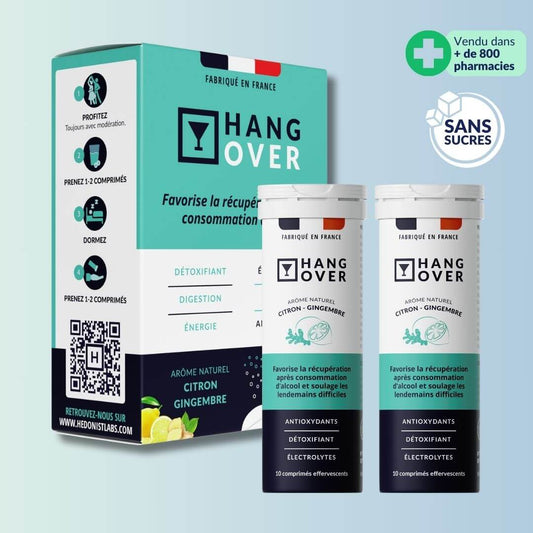
HANG-OVER helps break down alcohol thanks to three active ingredients: NAC, vitamin E, and grape seed extract. In this article, we’ll explain in more detail how each of these ingredients works.
NAC (N-Acetyl-L-Cysteine)
Acetaldehyde, a toxic breakdown product of ethanol that is harmful to our bodies and especially to the liver, is produced during the breakdown of alcohol.
To break down acetaldehyde, the body uses two enzymes: aldehyde dehydrogenase and glutathione. This metabolic cascade is effective, but it quickly becomes saturated when glutathione is lacking, leading to numerous undesirable effects.
Fortunately, this problem can be solved by specifically supplying the body with NAC .[1]
The body's most powerful antioxidant is glutathione. [ 2]
Most foods contain it, but our digestive system has a hard time absorbing it, and it breaks down before it enters the body. It plays an important role in liver detoxification and in the functioning of the immune system.
It also helps the body eliminate toxins from food and the environment. Glutathione is derived from glutamic acid, cysteine , and glycine are formed.
Of these three building blocks, the body is most likely to be deficient in L-cysteine. N-acetyl-L-cysteine (NAC) is a precursor to L-cysteine. Supplementation with NAC therefore provides the body with L-cysteine, which promotes the biosynthesis of glutathione —in other words, it replenishes the body’s reserves.[3]
Higher glutathione levels support the detoxification process, as glutathione acts directly as an antioxidant and scavenges free radicals. NAC has therefore been identified as a therapeutic option for certain conditions caused by the formation of free radicals .[4]
The right amount of glutathione supports the immune system and helps neutralize toxins.
NAC also helps prevent liver damage
Numerous studies have shown that NAC helps prevent liver damage caused by alcohol consumption.[5] The effectiveness of its liver-protective action has been demonstrated through its clinical use in cases of acetaminophen poisoning: when administered correctly and at the right time, it neutralizes liver damage. It is referred to as an antidote for acetaminophen poisoning.[6]
The dosage used in these studies suggests that NAC should be taken before drinking alcohol . This glutathione production is active and can meet the body’s metabolic needs and effectively eliminate the toxic breakdown products of ethanol.
Vitamin E
During the breakdown of alcohol, acetaldehyde, when present in excessive amounts, free radicals (nitrogen and oxygen species), which are are toxic to the body.
Vitamin E is an antioxidant that we must obtain through our diet, because the body cannot produce it on its own. It protects polyunsaturated fatty acids (the “good” fats) and other components of cell membranes (e.g., low-density lipoproteins) from oxidation by free radicals.[7,8,9]
100 years of research have shown that vitamin E possesses numerous antioxidant properties, such as the ability to scavenge reactive oxygen and nitrogen species.[10] Vitamin E is the most abundant and potent radical-scavenging antioxidant in vivo. [11]
Vitamin E is therefore essential for eliminating free radicalsproduced by alcohol consumption.
Grape Seed Extract
Oxidative stress is the loss of balance between the oxidative and antioxidant systems of cells and tissues, leading to an excess of reactive oxygen species (ROS: free radicals, oxygen ions, peroxides)
Grape seed extract is rich in oligomeric proanthocyanidins (OPC).
The proanthocyanidins in grape seeds have been shown to be free radical scavengers that are more potent than vitamins C and E and β-carotene—both in vitro and in vivo.[12,13]
The best-documented mechanism of action is the inhibition of lipid peroxidation: It prevents the formation of ROS and thus protects cell membranes from apoptosis (programmed cell death).
Researchers have reported that proanthocyanidin extracts from grape seeds restore balance to cellular redox status —via the pathways of glutathione synthesis.[14] Another study reported that grape seed procyanidins had a protective effect against ethanol-induced toxicity in the brain cells of mice.[15]
This combination of antioxidants (vitamin E, OPC, and NAC) is a smart choice for dealing with veisalgia, or a hangover. Based on the principle of prevention and detoxification , it helps neutralize free radicals and counteracts the damage caused by oxidative stress. In addition, this combination stimulates the biosynthesis of glutathione, which helps the body eliminate the toxins produced by excessive alcohol consumption.
[1] Morozova TV, Goldman D, Mackay TF, Anholt RR. The genetic basis of alcoholism: multiple phenotypes, many genes, complex networks. Genome Biol. 2012;13(2):239. Published 2012 Feb 20. doi:10.1186/gb-2012-13-2-239.
[2] Elgindy EA, El-Huseiny AM, Mostafa MI, Gaballah AM, Ahmed TA. N-acetyl cysteine: could it be an effective adjuvant therapy in ICSI cycles? A preliminary study. Reprod Biomed Online. 2010;20(6):789-796.
[3] Pieralisi A., Martini C., Soto D., Vila M.C., Calvo J.C., Guerra L.N. N-acetylcysteine inhibits lipid accumulation in mouse embryonic adipocytes. Redox Biol. 2016;9:39-44. doi: 10.1016/j.redox.2016.05.006.
[4] Shahin AY, Hassanin IM, Ismail AM, Kruessel JS, Hirchenhain J. Effect of oral N-acetyl cysteine on recurrent preterm labor following treatment for bacterial vaginosis. Int J Gynaecol Obstet. 2009;104(1):44-48.[23] Tunek A. Possible mechanisms behind the anti-inflammatory effects of N-acetyl cysteine; is metabolism essential? Eur Respir Rev. 1992; 2(7): 35-38.
[5] N-acetyl cysteine in the treatment of alcohol use disorder in patients with liver disease: Rationale for further research. Kirsten C. Morley, Andrew Baillie, Wim Van Den Brink, Kate E. Chitty, Kathleen Brady, Sudie E. Back, Devanshi Seth, Greg Sutherland, Lorenzo Leggio & Paul S. Haber. Pages 667-675 | Received 28 Mar 2018, Accepted 13 Jul 2018, Accepted author version posted online: 18 Jul 2018, Published online: 01 Aug 2018
[6] Acetaminophen Toxicity Treatment & Management, Updated: Jan 17, 2020 author heading Author: Susan E Farrell, MD; Chief Editor: Michael A Miller
[7] World Health Organization (WHO) Food and Agriculture Organization (FAO) Vitamin and Mineral Requirements in Human Nutrition: Report of a Joint FAO/WHO Expert Consultation, Bangkok, Thailand, 21-30 September 1998. WHO, FAO; Geneva, Switzerland: 2004.
[8] Sato K, Niki E, Shimasaki H. Free radical-mediated chain oxidation of low density lipoprotein and its synergistic inhibition by vitamin E and vitamin C. Arch Biochem Biophys. 1990.
[9] Bowry VW, Ingold KU, Stocker R. Vitamin E in human low-density lipoprotein: when and how this antioxidant becomes a pro-oxidant. Biochem J. 1992.
[10] Zingg J.-M. Vitamin E: An overview of major research directions. Mol. Asp. Med. 2007.
[11] Jasmeet Kaur 1, Sonia Shalini, M P Bansal. Influence of vitamin E on alcohol-induced changes in antioxidant defenses in mice liver. Toxicol Mech Methods.2010 Feb
[12] Rani V., Deep G., Singh R.K., Palle K., Yadav U.C. Oxidative stress and metabolic disorders: Pathogenesis and therapeutic strategies. Life Sci. 2016.
[13] Bagchi D., Swaroop A., Preuss H.G., Bagchi M. Free Radical Scavenging, Antioxidant and Cancer Chemoprevention by Grape Seed Proanthocyanidin: An Overview. Mutat. Res. Fundam. Mol. Mech. Mutagen. 2014.
[14] Grape seed procyanidins prevent oxidative injury by modulating the expression of antioxidant enzyme systems. Puiggros F, Llópiz N, Ardévol A, Bladé C, Arola L, Salvadó MJJ Agric Food Chem. 2005 Jul 27.
[15] Direct in vivo evidence of protective effects of grape seed procyanidin fractions and other antioxidants against ethanol-induced oxidative DNA damage in mouse brain cells. Guo L, Wang LH, Sun B, Yang JY, Zhao YQ, Dong YX, Spranger MI, Wu CF J Agric Food Chem. 2007 Jul 11.



 10 Rue de la Paix 75002 PARIS


